
Greene County Projected Release Dates
A projected release date is a calculation based on the information currently in the agency's record. Illinois IDOC uses the label Projected Parole Date for an incarcerated profile. A profile for someone already on parole can instead show a Parole Date and Projected Discharge Date. These fields mark different stages.
Projected parole anticipates movement out of prison confinement and onto supervision. Projected discharge anticipates completion of the remaining sentence or supervision. Actual release is the recorded custody event. Court changes, sentence-credit decisions, discipline, another hold, or parole action can move the expected date before that event occurs.
A pretrial detainee at the Greene County Jail has no sentence-based projected date. Release depends on the court's detention or release order and any other holds. A person serving a county-jail sentence may have a local calculation, but IDOC will not calculate it unless that person was committed to state custody.
Lookup Greene County Release Dates
First determine who controls custody. The Greene County Sheriff's Office holds county detainees, while IDOC controls state prisoners, including the state system associated with Greene County Work Camp. A court docket shows the sentence or order, but it is not a live custody ledger. Match the source to the person before reading a date.
- Identify the holding agency from the most recent reliable custody or court record.
- For an IDOC commitment, open the IDOC Individual in Custody Search and search by name or IDOC number.
- Compare identifiers, county, offense, mittimus, and custody facts so the profile belongs to the right person.
- Read Projected Parole Date on an incarcerated profile, or Parole Date and Projected Discharge Date on a parole profile.
- For a county-jail sentence, ask the jail for its computation sheet or actual release record and compare it with the judgment and custody credit.
- For a pretrial case, check the court order and ask whether another hold prevents release.
The home page's Greene County released-inmate lookup covers the broader verification chain. A state profile is not the right source for every person booked at the county jail. Conversely, a sheriff record cannot establish final discharge from IDOC.
Note: A transfer from Greene County Jail to IDOC is a county release event but is not a return to the community.
IDOC Release Fields for Greene County
An IDOC profile provides context for the projected date. Read the date together with the sentence fields. A profile can show the mittimus, offense, custody date, imposed sentence, county, and a per-count marker labeled SENTENCE DISCHARGED? YES/NO. One discharged count does not establish that every count has ended.
| IDOC field | How to read it |
|---|---|
| Offender status | Whether IDOC reports incarceration, parole, or another state status |
| Projected Parole Date | Expected transition from prison confinement, subject to change |
| Parole Date | The recorded start of parole or supervised release |
| Projected Discharge Date | Expected completion of the state sentence or supervision |
| Sentence discharged | Whether the listed count has been marked complete |
| Mittimus and county | The commitment record and county tied to that sentence |
The public live search may no longer carry a person after final discharge. In that case, use IDOC's archived Record Search or records request route. Keep the IDOC record distinct from the county booking and release record, even when the court case began in Greene County.
Illinois Credit for Greene County Sentences
The court-imposed sentence and jail custody credit form the starting point. IDOC then applies the offense-specific sentence-credit category under 730 ILCS 5/3-6-3. The exact offense subsection, offense date, concurrent or consecutive structure, and later amendments control. Broad labels such as violent or nonviolent are not enough to calculate a date.
Listed first-degree murder and terrorism categories can receive no sentence credit and effectively require the full sentence. Enumerated serious offenses are capped at 4.5 credit days per month, commonly described as an 85 percent floor. Enumerated drug offenses can be capped at 7.5 days per month, a 75 percent structure. Many offenses not listed in those groups receive one day of credit for each day served, often described as a 50 percent structure.
These are statutory categories, not a personal calculation. It is inaccurate to say that every violent offense requires 85 percent. The specific subsection must be matched to the judgment and offense date. Consecutive sentences also require a different calculation from concurrent sentences.
Greene County Sentence-Credit Source
The official Illinois General Assembly sentence-credit text is the source for the statutory floors that affect an IDOC projected release date.
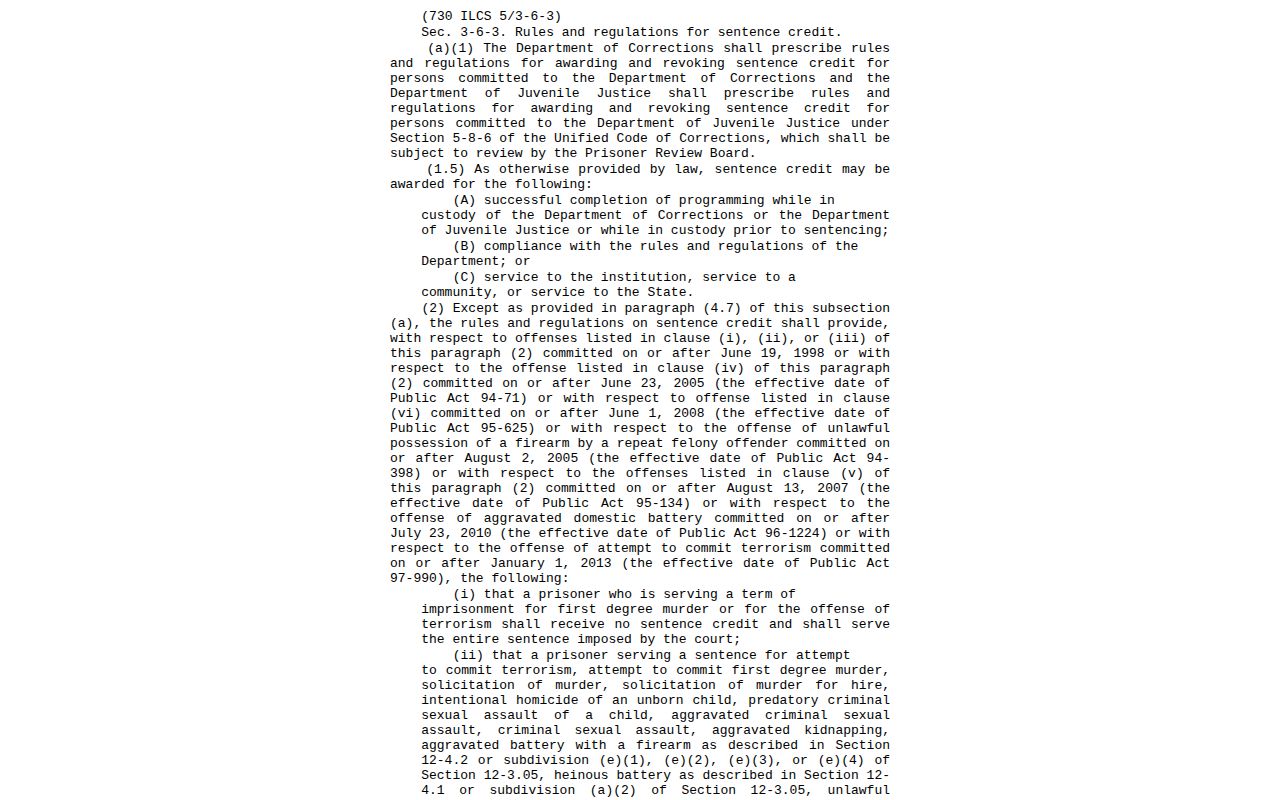
The statute must be applied to the correct conviction and offense date; the screenshot is a reference to the law, not a date calculator.
Greene County Earned Credit Limits
Earned discretionary sentence credit is not automatic. IDOC says general eligibility requires statutory eligibility and more than 60 days served. Evaluation can consider risk and needs assessment, the circumstances of the offense, forcible-felony history, disciplinary conduct, program participation, and required treatment. IDOC does not predict whether or when a specific person will receive an award.
Administrative rules appear in 20 Ill. Adm. Code 107.210. Extra credits cannot break the governing statutory floors. They cannot reduce an 85 percent sentence below 85 percent. A 75 percent sentence generally cannot fall below 60 percent, while gunrunning remains at 75 percent. A 100 percent sentence cannot fall below 100 percent.
Credits may be awarded, revoked for discipline, and restored. That is one reason a public projected date can move. A searcher cannot infer an award from program attendance or good conduct. Only the official sentence calculation reflects what IDOC has actually applied.
Note: Earned discretionary credit is an IDOC decision within statute and rule, not a guaranteed deduction available on request.
Why Greene County Release Dates Change
A displayed date is the output of the current record. When the inputs change, the date can change. The reason may arise from custody credit, the sentence itself, agency action, or another jurisdiction. A later date does not by itself identify misconduct, and an earlier date does not prove immediate release.
| Factor | Possible effect |
|---|---|
| Credit award or restoration | May move the projected date earlier within legal floors |
| Credit revocation | May move the date later after disciplinary action |
| Corrected mittimus | Changes the commitment information used in the calculation |
| Jail-credit correction | Changes time credited before IDOC custody |
| Concurrent or consecutive recalculation | Changes how multiple sentences combine |
| Detainer or hold | May prevent community release even when one custody term ends |
| Parole or PRB action | Can affect the transition to supervision or revocation status |
A detainer is a request or hold from another authority. It can result in transfer rather than release to the community. Court amendments and sentence-credit corrections should be checked against the public docket and official agency record instead of being reconstructed from an old projected date.
Greene County Jail Date Calculations
The Greene County Jail and IDOC use different records. For a local sentence, ask the jail for the computation sheet or actual release record. Compare it with the court judgment and the custody credit shown in the case. The sheriff's official page does not publish a date calculator, recent-release feed, or public roster from which a future date can be derived.
A pending pretrial case turns on the detention or release order, not sentence credit. A court may order release, yet another warrant or hold may keep the person in custody. Ask whether the jail has completed the release event and whether the person went to the community or another authority. Do not convert a court date, bond event, or VINE alert into a sentence calculation.
The Greene County Work Camp is an IDOC facility associated with Jacksonville Correctional Center. A departure from that site can be a transfer within IDOC. Use the statewide profile and archived state records for its custody and discharge path, not the Greene Sheriff.
Confirm Greene County Actual Release
Use the agency that owns the custody record. For IDOC, compare the live offender status, actual parole date, and any sentence-discharge markers. For the Greene County Jail, request the actual release record with the event time, release type, authority, and receiving agency when available. The court docket supplies the order or sentence behind the event.
Illinois VINE can send a pending custody-change alert. The Greene County VINE inmate check explains registration and the telephone PIN. An alert is valuable, but agency confirmation remains essential because data can lag and a transfer can appear as release from one source.
When a date has passed but the status has not changed, do not assume either the portal or the date proves release. Recheck the current profile, ask about holds, and compare the latest court action. For a person no longer in the IDOC live search, request the archived state record needed to document final discharge.